papers
You can find a list of my publications from whichever source you prefer.
2026
- arXiv
 The Via Project: Overview of the Science, Instrument, and SurveyThe Via Collaboration2026
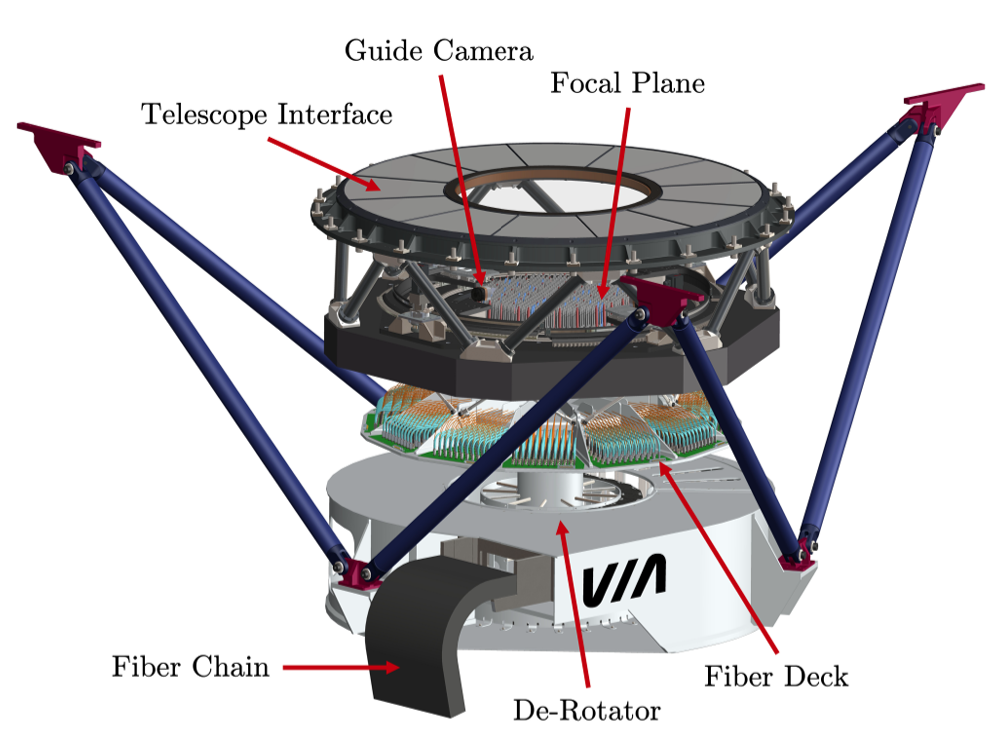
Via is a forthcoming all-sky spectroscopic survey that will achieve 100 m s^-1 radial velocity stability for millions of faint (G ≲21) stars while reaching LSST’s single-visit depth (r ≈24) for transient spectroscopy, opening new regimes in near-field cosmology and time-domain astrophysics. Via will deploy identical fiber-fed, multi-object spectrographs on the 6.5m MMT and Magellan/Clay telescopes for a five-year, dual-hemisphere survey of >2,000,000 stars beginning in 2027 - timed to complement LSST. Each instrument has 576 robotically positioned fibers over a 1^∘ field of view, feeding two spectrographs: Viaspec (R ≈15,000; 505-595 nm; 540 fibers) and Boombox (R ≈1,000; 360-1010 nm; 36 fibers). Four key goals drive the survey: (1) a comprehensive survey of velocity perturbations in cold stellar streams, sensitive to M ≲10^7 subhalos below the threshold of galaxy formation, a stringent test of the particle nature of dark matter; (2) a chemodynamical census of Milky Way satellite galaxies to understand the formation of the faintest galaxies; (3) the first 3D tomographic maps of cold gas in the circumgalactic medium via NaI absorption; and (4) the rapid characterization of thousands of transients to the single-epoch survey depth of LSST. Ancillary science - including the Lyαforest at z ≈3-4, polluted white dwarfs, exoplanet host characterization, fast radio burst host galaxies, and extragalactic dwarf galaxies - will leverage spare fibers in every pointing. The Via Project is a collaboration between the Center for Astrophysics | Harvard & Smithsonian, Carnegie Observatories, Stanford University, and Yale University.
- arXiv
 GraphGP: Scalable Gaussian Processes with Vecchia’s ApproximationBenjamin Dodge, Philipp Frank, and Susan E. ClarkStanford Conference on Physics and AI, 2026
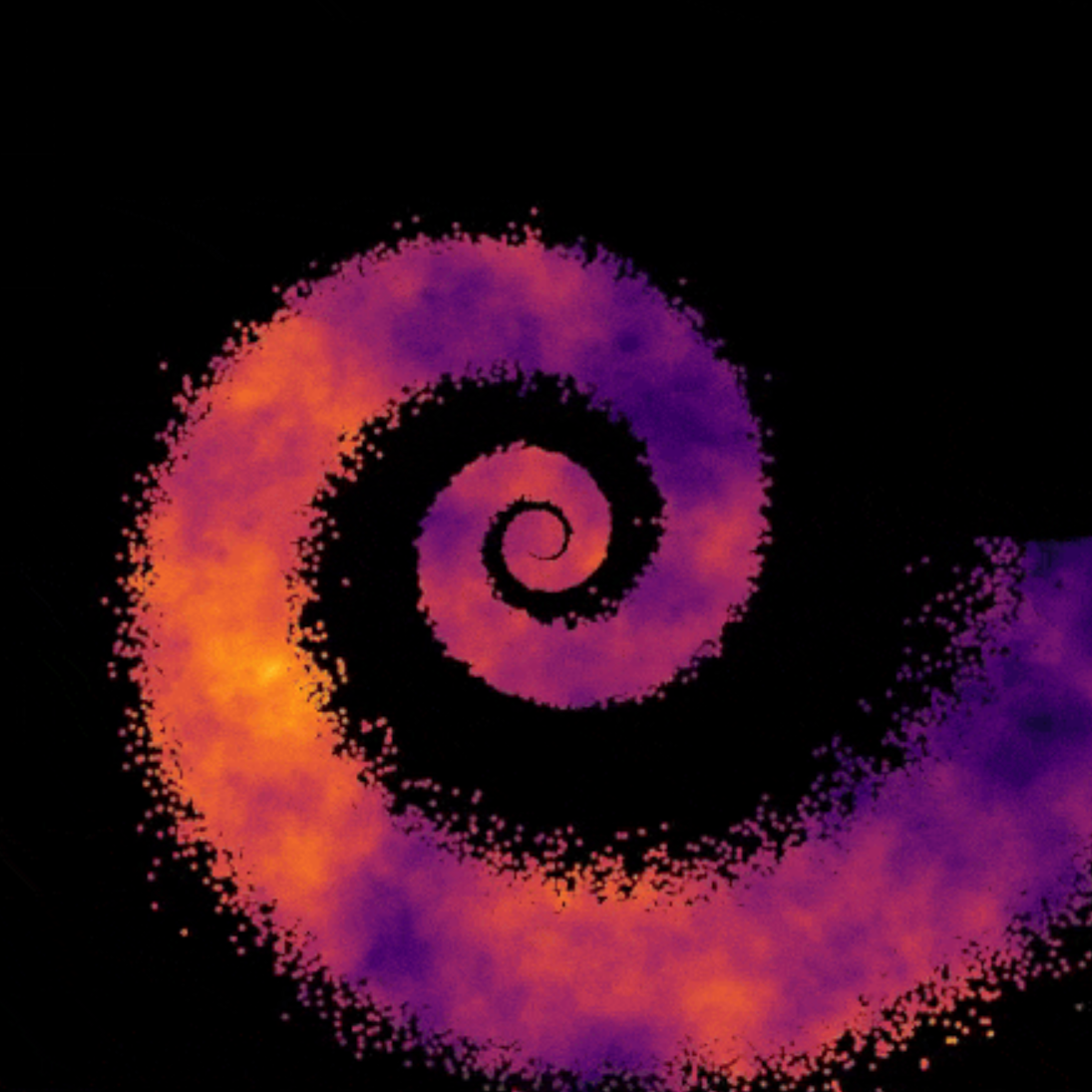
Gaussian processes are a powerful tool for modeling continuous fields, but their naive O(N^3) computational cost and O(N^2) memory requirement often limit their practical use. Vecchia’s approximation is a sparse precision matrix approximation for stationary, decaying kernels that conditions each point only on its k nearest neighbors. We present GraphGP, a GPU algorithm for Vecchia’s approximation that scales to nearly a billion parameters with linear time and memory requirements, handling arbitrary point distributions over a large dynamic range. Our key contributions are (1) a bit-reversed k-d tree ordering that allows efficient neighbor searches while also maximizing batch parallelism, and (2) a differentiable CUDA implementation, which is substantially faster and more memory efficient than our pure JAX baseline. GraphGP provides the building blocks for inference, including forward generation, inverse application, log-determinant, and kernel parameter derivatives.
2022
- MNRAS
 Dynamics of Stellar Disc Tilting from Satellite MergersMonthly Notices of the Royal Astronomical Society, Nov 2022
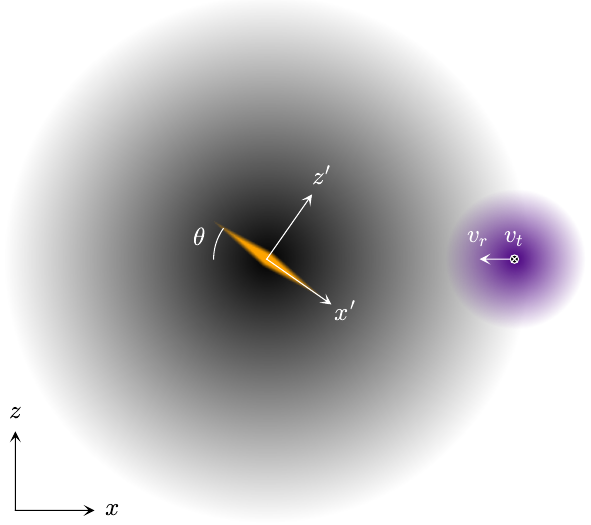
The Milky Way’s stellar disk can tilt in response to torques that result from infalling satellite galaxies and their associated tidal debris. In this work, we explore the dynamics of disk tilting by running N-body simulations of mergers in an isolated, isotropic Milky Way-like host galaxy, varying over satellite virial mass, initial position, and orbit. We develop and validate a first-principles understanding of the dynamics that govern how the host galaxy’s stellar disk responds to the satellite’s dark matter debris. We find that the degree of disk tilting can be large for cosmologically-motivated merger histories. In particular, our results suggest that the Galactic disk may still be tilting in response to Gaia-Sausage-Enceladus, one of the most significant recent mergers in the Milky Way’s history. These findings have implications for terrestrial direct detection experiments as disk tilting changes the relative location of the Sun with respect to dark matter substructure left behind by a merging galaxy.
2021
- EMNLP
 Single-dataset Experts for Multi-dataset Question AnsweringDan Friedman, Ben Dodge, and Danqi ChenIn Proceedings of the 2021 Conference on Empirical Methods in Natural Language Processing, Nov 2021
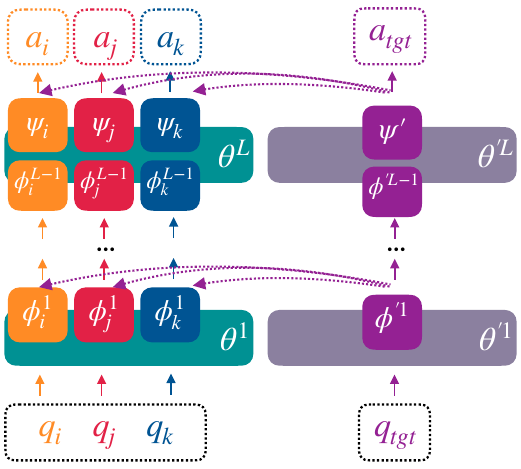
Many datasets have been created for training reading comprehension models, and a natural question is whether we can combine them to build models that (1) perform better on all of the training datasets and (2) generalize and transfer better to new datasets. Prior work has addressed this goal by training one network simultaneously on multiple datasets, which works well on average but is prone to over- or under-fitting different sub- distributions and might transfer worse compared to source models with more overlap with the target dataset. Our approach is to model multi-dataset question answering with an ensemble of single-dataset experts, by training a collection of lightweight, dataset-specific adapter modules (Houlsby et al., 2019) that share an underlying Transformer model. We find that these Multi-Adapter Dataset Experts (MADE) outperform all our baselines in terms of in-distribution accuracy, and simple methods based on parameter-averaging lead to better zero-shot generalization and few-shot transfer performance, offering a strong and versatile starting point for building new reading comprehension systems.